 by
by The Southern part of Madagascar is currently experiencing the worst drought in four decades. This has resulted in a humanitarian crisis; the lack of rain has made it impossible to grow food over a long period of time, and has forced many to migrate to other parts of the country to survive. Those who are left in the south survive on what little food they can find, but it is not enough to sustain them. They have been surviving on eating locusts, cactus, roots, and plants that are usually fed to animals. In desperation, some have mixed white clay in with their food, just to quieten the intensity of the hunger they feel.
The World Food Programme and the Malagasy government are helping many, but it was drawn to our attention that people without national identity cards are struggling to get the help. Through Together in Bible Translation, some churches abroad have raised funds to help. The Ntandroy translation team went to the south to get an overview of those who urgently needed to be helped. Later the team used these funds to buy food and went back to these villages to distribute food and other aid. This is a report from one of the back-translators of the Ntandroy team:
When our colleagues from abroad heard about the famine in the south of Madagascar, they sent us money to support some of those affected by the crisis. The Ntandroy translation team received that money and bought food for distribution.
When we arrived in the area where we were going to distribute food, we realised that there were many people who hadn’t received help from the WFP or state aid because they do not have national identity cards. It was decided that these were the people we should help. Our guidelines were not to consider whether they were Christians or not, but to help them regardless of religion, gender or status.
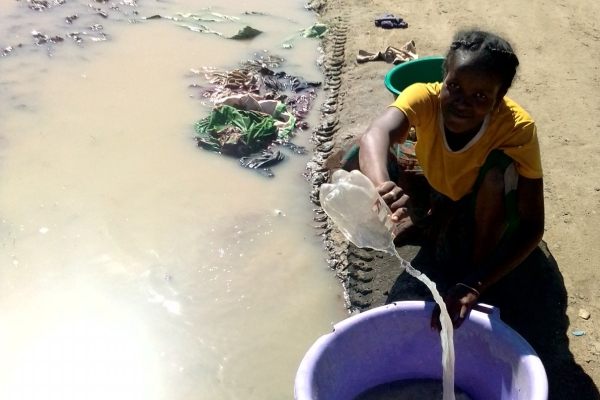
The day before I arrived in the south, at the end of September, it had rained. The village I visited had muddy puddles everywhere. My heart ached at seeing the mothers wash clothes in the stagnant water from these puddles as well as the children having to wash themselves in that same muddy water. They told me the water was less dirty early in the mornings, so that’s when they would wash.
I lived with them for 2 days and I witnessed their very difficult living conditions. I ate whatever food they ate. For the first time in my life, I ate ‘ambatry lena’. This is a type of pea that grows wildly along the coast. It is very bitter when eaten fresh. Normally it is dried in the sun before it is cooked, and I didn’t even know that it is possible to eat it. I learned that when it is prepared fresh, it has to be boiled twice: once to get rid of toxins and again in new water to cook it. This is rather challenging when there is lack of water. The pea was then mixed with a type of very bitter weed. The evening I arrived, during our first meal together I thought to myself: How do the elderly and the small children cope with eating this food? But I didn’t say anything out loud, but ate my food quietly. It was hard!
The next morning, at the time of the distribution of food, we saw many happy faces. We handed out rice, dried beans and corn, and also some money according to the needs of the people.
More than 600 households received aid from us at this time. They were very happy! One of the elderly men spoke on their behalf and thanked the people from abroad who helped. I was surprised when in his speech he compared me to Esther. After all I was only a messenger. It was you, the churches from abroad who came to their rescue, I just happen to be a fellow countryman. What really brought me joy with what the old man shared, was that I both saw and felt that Bible reading had become an important part of his life. I was very touched to hear that he could remember the whole story about Esther. It truly filled me with joy.
It was painful to see that the people were living in these conditions because of the famine. But although that was casting a shadow on them, they were very welcoming and we shared good conversations and valuable time together. I laughed with joy when as I was leaving, an old woman came up to me smiling and said: ‘We all ate rice last night!’ And I happily replied: ‘That’s good!’ (Rice is the most desirable food for most Malagasy people, even if they can’t have anything on the side.)
This is the message I want to pass on to you from those who were helped by your gifts: ‘He who gives is more blessed than he who receives’.
For me personally it was a blessing to be able to do this journey, even though it was emotionally difficult. As a bonus, I was able to go visit my relatives in Antanimora. It was especially good to be able to visit my elderly father who is nearly 100 years old. We hadn’t seen each other in a long time. Whilst I was there the children from the Sunday school came up to me and asked me to come to church with them. They wanted us to pray for rain. Until now they have only had a light drizzle of rain. In desperation, some people have started planting food in high hopes that there will be more rain. Let us pray together for rain to come so that they can harvest their crops!
May the God of peace be with us all.