by
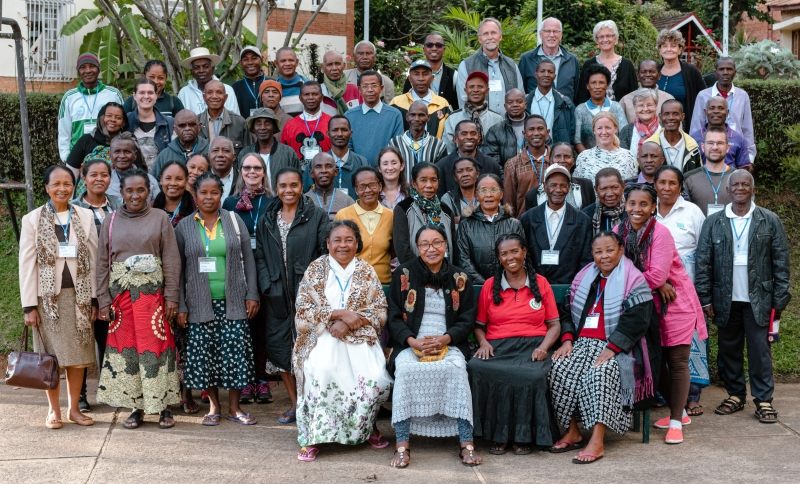
by There was much excitement and expectation in the air, as 60 local translators from nine different Malagasy languages finally got together for a long-awaited TiBT workshop. The workshop took place at Lovasoa, Antsirabe, during the first two weeks of June. Consultants from Madagascar, Norway, UK, South Africa, Canada, the Netherlands and Romania also participated. It was truly a cross-cultural happening!
The first national workshop since Covid-19
Due to the pandemic and funding issues, we haven’t been able to arrange any large workshops since 2019. Normally, there would be at least one workshop a year for spiritual, social, and professional input.
For many of the translators, everyday life can be challenging. Some teams have members living dispersed over a large area, and so they need to travel far for their regular working sessions. It can also be challenging to find space to work in their own areas.
Even so, the teams worked steadily throughout the pandemic. Many of them have now drafted, team-checked and tested large volumes of scripture, which had not yet been consultant checked.
A long way towards the goal
As I am still in training, I was appointed to sit in with experienced consultant Johanne Leinebø, who worked with the Antakaraña team. They were checking their translation of Acts chapters 7 to 12, preparing for community testing after the workshop. During the two weeks, we got through 246 verses. Some verses took us only minutes to go through, whereas we could spend an hour and more on other verses. Bible translation requires both time and thoughtfulness.
The dual loyalty of a translation
In Bible translation, we need to be loyal to two important principles. Firstly, both translators and consultants strive to contain the full message of the Greek and Hebrew source texts in the translations. Secondly, we emphasize that translation be both clear and natural, so that people really understand what God is communicating to them as they read or hear His Word. To make that happen, the flow and naturalness of the translation must be ensured. And the most important agents in this process are the mother tongue community and the translators themselves. They are experts in their own language. Our job, as we do consultant checking, is to facilitate the search for words, phrases, and idioms that can convey the original message of the original writers.
“And their spirits were drained”
The first chapters of Acts are brimming with signs and wonders performed by the Apostles. No wonder the crowds were beside themselves with wonder and amazement. How do you say that in Antakaraña? To be spiritless isn’t exactly the most cheerful thing you can say about someone in English. But, in Antakaraña “to have your spirit drained” means to be amazed and happy about something. So, the Antakaraña translation says that the crowds were lanifañahy because of what God did through the Apostles. Although causing conflict to the English reader, this surely makes great sense in Antakaraña. A good translation appropriately acknowledges and reflects both the Biblical and the receiving cultures. There you have the dual loyalty demonstrated – in all its simplicity and complexity.
A hard-to-break loyalty
“Every language has its own genius” with its devices and codes, as famously stated by Eugene Nida (in: The Theory and Practise of Translation (TAPOT), p. 3-4, 1974). Although the over 20 languages of the island are closely related linguistically, Madagascar is of course no exception to this basic insight. Just think about English as compared to for example Dutch or German.
Ironically, one of the challenges for translation work in Madagascar, is the fact that the Bible has already been available in the Official Malagasy language since the early 1800’s. Understandably, Christians tend to have a deep reverence and loyalty to the wording and phrasing of the Bible in Official Malagasy. It is only natural, of course, to lean towards the way we are used to hearing God’s Word. But it causes some bumps in the translation work, and it normally takes some time for the translators to be confident enough to express God’s Word in their own natural language.
The blessed difference
When checking the translations, we always read aloud the entire passage, typically 10 to 15 verses. Usually, you can tell rather easily from the dedication of the reader whether the translation is natural or leans too much towards the Official Malagasy. However, when the team has produced natural Antakaraña for instance, it speaks to them in a whole different way, and it greatly influences the way they read it.
For both the team and the consultants it is a delight to experience this difference, but more importantly: naturalness makes a major difference for the people out there in the villages. Through the years they often have been accustomed to hearing the Scriptures read or taught in the official language, which most of them do not understand particularly well, if at all. When they go to church and hear the Scriptures in their own mother tongue, “their spirits are drained” as the Antakaraña say. Well, really, it’s quite the opposite that happens: the Holy Spirit is rushing and rustling, filling peoples’ hearts with the meaning of Scripture like never before. People start believing in Christ, and have their lives changed in profound ways.
What a blessing it is to be a part of this work!