by
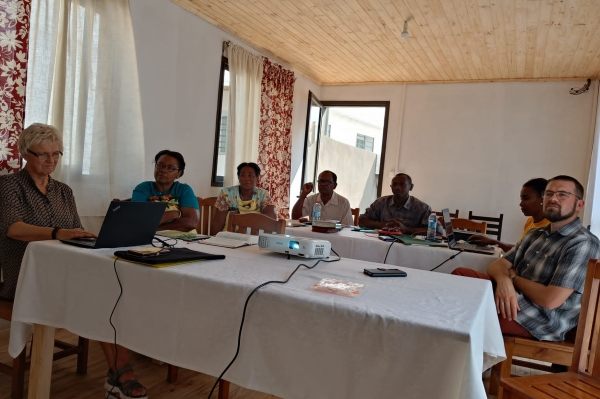
by As a newcomer in TiBT, who has planned for a year to move to Madagascar, joining the Antakaraña and Bara workshop in Antsirabe this November was a treat long sought. For two weeks I got to work with the two teams along with Johanne and Bjørn Leinebø. Here are some insights from my first TiBT workshop.
1. Translation takes time!
When we gathered in Antsirabe, the teams had finished drafts for translation. We worked through the drafts, verse by verse, to check what was there. Had the translators understood the text properly? Was the language used fluent and clear? What does it communicate to them in their own language? Was there anything from the Greek or Hebrew that hadn’t made it into the translation? Translation and checking are really a cross-cultural happening!
Now, how many verses can one check in one hour? Sometimes only one. Other times you can do 10. There are so many complex issues in the texts that need careful consideration and discussion. The meaning of a single word, the tense or mode of a verb, the little filling words that every language use to make sentences flow the right way… How does God speak in Bara or Antakaraña?
2. The relation between the official Malagasy translations and the new ones in tenim-paritra [local languages] is not a problem-free one!
This is one of the areas where the translators often need to be liberated from mental captivity. Our task now is to let the Spirit continue his work from the first Pentecost as recounted in Acts 2. That time, people from the entire world (as seen from Jerusalem in the 1st century AD, of course) could suddenly hear their own language spoken by the Apostles, who proclaimed God’s marvellous works in languages they didn’t know from before. It was a miracle of the Holy Spirit. Through this, we learn that any language is suitable for speaking about God. Even Antakaraña and Bara.
Interestingly, in Acts there is no report of confusion regarding the content of the message, or any sign that the languages were flawed in any way. Bjørn reminded one of the teams that even the Bible in the official Malagasy language is a translation! It is useful for our work, but it is not the norm and shouldn’t be an idol.
3. Translation can be done in different ways.
Before we came to Madagascar, I had the privilege to work as a primary translator with the Norwegian Bible Society. I would translate the Greek texts of the NT into Norwegian, and then have it discussed in different groups before finishing the draft.
In TiBT, the work is done slightly differently. Very few of the people in the groups know Greek or Hebrew and it would take a very long time for them to learn it well. Therefore, they translate from the different translations in official Malagasy. In every team there are people whose language remain uninfluenced by the way people talk in the capital or in the big hubs around the island. Only thus can we ensure fluency. Of course, every team also have people who are well acquainted with official Malagasy and the Bible. Along with consultants with knowledge of the biblical languages, accuracy is ensured. Together we do the job.
4. The need for translation is very real!
Madagascar is a fairly large island. The travel distance from Diego in the far North to Antsirabe in the middle of the island is an endeavour in and of itself. This allows languages to live on the island without much contact. We asked the team members from Bara how much they understand when the Antakaraña spoke. I was baffled by their response: They understood about 10 %! During the two weeks the distinctiveness of each language was evident, but 10 % is not much at all. It roughly equals my understanding of spoken Dutch – a language related to my mother tongue Norwegian, spoken in a different country.
Then the question was posed to the Antakaraña team. “Well, we understand about 10 % of the Baras as well. But those two guys over there,” they said pointing towards the two Bara men who still live in their native village, “we understand nothing when they speak to one another!”
5. Meeting face to face is important!
During Covid, many learned of the great possibilities granted by online meetings. But surely nothing can beat the boost of being together. Seeing the smiles of the people around you, talking in the hallways, drinking coffee, singing, and praying together in the same place is of incomparable importance. All these things that are not strictly related to the translation and checking but are a part of the work all the same.
I find myself blessed by the company of colleagues and look forward to meeting more and more teams in times to come.